Eclipse Dataspace Working Group (EDWG) Integration (Data Plane Signaling, DSP, DCP, CAP v2.2.1, DRP)
ODGS (v6.1.0) integrates as a consumer-side data-plane constraint evaluator and first-party cryptographic audit recorder alongside connectors implementing the Eclipse Dataspace Working Group (EDWG) specifications:
- Data Plane Signaling — Runs as (or behind) a consumer data plane registered with the consumer control plane (
DataPlaneSignalingBridge), handlingDataFlowPrepareMessage/DataFlowStartMessage(processId/dataFlowId+agreementId) and retrieving the negotiated agreement viaGET /transfers/:dataFlowId/agreement. - Eclipse Dataspace Protocol (
DSP v2025-1/ISO/IEC DIS 26450) — Drives evaluation from the negotiatedodrl:Agreement, bindsagreementIdand transfer process ID into theS-Certcorrelation_id, and emitsdspace:TransferSuspensionMessage(SOFT_STOP) ordspace:TransferTerminationMessage(HARD_STOP) on violation so the consumer control plane can notify the provider. - Eclipse Decentralized Claims Protocol (
DCP v1.0/ISO/IEC DIS 26451) — Issues runtime audit evidence as a W3C Verifiable Credential (cap:Declaration) signed with a key from the consumer'sdid:webdocument, held in the consumer'sCredentialService, and presented to a provider viaPresentationQueryMessage→PresentationResponseMessage(handle_dcp_presentation_query) as a policy condition for subsequent negotiations or transfers. - Eclipse Conformity Assessment Policy (
CAP v2.2.1) — ProjectsS-Certaudit receipts intocap:Declaration(ISO/IEC 17000 first-party self-declaration) andcred:Evidence(export_cap_declaration_vc,export_cap_cred_evidence). - Eclipse Dataspace Rights Profile (
DRP) — Evaluates payload-observabledelegationEvidencelicense and resource constraints (bind_drp_delegation_evidence).
Scope Boundary (Integration vs. Re-Implementation): ODGS does not re-implement control-plane contract negotiation, credential transport, or signaling state machines; instead, it integrates with a compliant consumer control plane (such as Eclipse EDC) at the control-to-data-plane boundary.
1. Trust Model & Constraint Observability Boundary
To ensure architectural precision in cross-organizational dataspace deployments, ODGS states its trust assumptions and observability boundaries explicitly:
- Consumer-Signed First-Party Audit Record (
CONSUMER_FIRST_PARTY_AUDIT_RECORD): S-Certreceipts are generated and signed by the consumer within its own processing pipeline over payload values supplied by the consumer.- Accordingly, an
S-Cert(and its projectedcap:DeclarationVerifiable Credential under ISO/IEC 17000) records that the consumer attests to having executed a deterministic check over a specific payload digest (payload_hash) and rule digest (semantic_hash) underagreementId. It serves as a tamper-evident audit record, not provider-verified proof of policy enforcement. - Payload-Observable Constraints vs. Unobservable Usage Obligations (
inspect_odrl_constraint_observability): - Observable in-payload prior to processing: Structural, schema, value-range, and aggregation constraints over payload fields (e.g.,
aggregation_household_count >= 50, value bounds, or schema completeness). - Not observable by pre-processing payload inspection: Behavioral constraints on downstream use — such as
purpose(odrl:purpose),retention(odrl:elapsedTime/odrl:dateTime), oronward sharing(odrl:distribute/odrl:share). inspect_odrl_constraint_observability()explicitly classifies every ODRL policy intoobservable_payload_operandsandunobservable_usage_constraintsso neither consumers nor providers mistake pre-processing payload checks for verification of downstream behavioral usage.
2. Data Plane Signaling & DSP Transfer Lifecycle (odgs.dataspace.signaling)
When deployed as (or behind) a consumer data plane registered with a consumer control plane:
- Flow Preparation (
DataFlowPrepareMessage/DataFlowStartMessage): The consumer control plane sends a prepare/start signaling message containingagreementIdandprocessId/dataFlowId(equal to the DSP transfer process ID). - Agreement Retrieval (
GET /transfers/:dataFlowId/agreement):DataPlaneSignalingBridgecalls the control plane's agreement retrieval endpoint (build_agreement_retrieval_path(data_flow_id)) viaAgreementResolverto fetch the negotiatedodrl:Agreementand classify constraint observability. - Violation Signaling (
TransferSuspensionMessage/TransferTerminationMessage): If an observable payload constraint fails duringevaluate_flow(), the bridge produces adspace:TransferTerminationMessage(HARD_STOP) ordspace:TransferSuspensionMessage(SOFT_STOP) referencing thedataFlowId(dspace:consumerPid),dspace:providerPid, andS-Certdigest so the consumer control plane can suspend or terminate the transfer with the provider.
from odgs.dataspace import (
    DataPlaneSignalingBridge,
    build_agreement_retrieval_path,
)

# Consumer data plane resolves GET /transfers/:dataFlowId/agreement on the consumer control plane
bridge = DataPlaneSignalingBridge(
    agreement_resolver=control_plane_client,
    control_plane_notifier=control_plane_client,
    system_id="consumer-dataplane-01",
)

# 1. Control plane sends DataFlowPrepareMessage (dataFlowId == DSP transfer process ID)
response = bridge.prepare_flow(
    signaling_message={
        "@context": "https://w3id.org/dspace/2025/1/dps/context.jsonld",
        "@type": "DataFlowPrepareMessage",
        "processId": "urn:uuid:dsp-transfer-flow-7701",
        "agreementId": "urn:uuid:dsp-agreement-grid-2026-44",
        "providerPid": "urn:uuid:provider-transfer-pid-88",
    },
    process_urn="urn:odgs:process:consumer:dataplane-ingest",
)

# 2. Evaluate incoming flow payload; on HARD_STOP emits dspace:TransferTerminationMessage
result = bridge.evaluate_flow(
    data_flow_id="urn:uuid:dsp-transfer-flow-7701",
    payload={"aggregation_household_count": 82, "region": "NL-ZH"},
)
# result.trust_model == "CONSUMER_FIRST_PARTY_AUDIT_RECORD"
# result.s_cert.correlation_id == "urn:uuid:dsp-agreement-grid-2026-44#transfer:urn:uuid:dsp-transfer-flow-7701"
3. Direct Eclipse DSP Binding (DSP v2025-1 / ISO/IEC DIS 26450)
Eclipse DSP Message / Construct (https://w3id.org/dspace/2025/1/context.jsonld) |
Control-Plane Role in DSP (ISO/IEC DIS 26450) |
Data-Plane Role in ODGS (odgs.dataspace) |
|---|---|---|
dspace:ContractAgreementMessage & GET /transfers/:dataFlowId/agreement |
Finalizes and exposes the negotiated odrl:Agreement between dspace:providerId and dspace:consumerId. |
Ingested by DataPlaneSignalingBridge / bind_dsp_contract_agreement() to compile payload-observable constraints and classify unobservable usage terms. |
dspace:TransferStartMessage |
Signals transfer execution via dspace:consumerPid, dspace:providerPid, and dspace:agreementId. |
Verifies dspace:agreementId continuity and binds correlation_id = "<agreementId>#transfer:<consumerPid>" into emitted S-Cert audit records. |
dspace:TransferSuspensionMessage / dspace:TransferTerminationMessage |
Notifies the provider when a consumer control plane suspends or terminates a transfer process. | Emitted by build_dsp_transfer_suspension_message() (SOFT_STOP) and build_dsp_transfer_termination_message() (HARD_STOP) with S-Cert event and digest references. |
4. Eclipse DCP Credential Issuance & Presentation (DCP v1.0 / ISO/IEC DIS 26451)
Under Eclipse DCP, runtime audit records can be issued as W3C Verifiable Credentials (cap:Declaration) signed directly with a key from the consumer's did:web document, stored in the consumer's CredentialService, and presented to a provider via a DCP PresentationQueryMessage → PresentationResponseMessage flow. A provider can require this audit credential in policy as a condition for subsequent contract negotiations or transfers:
from cryptography.hazmat.primitives.asymmetric.ed25519 import Ed25519PrivateKey
from odgs.dataspace import (
    export_cap_declaration_vc,
    handle_dcp_presentation_query,
    sign_s_cert_ed25519,
    verify_cap_declaration_vc,
)

consumer_did = "did:web:consumer.energy-dataspace.eu"
did_key_id = f"{consumer_did}#key-ed25519-1"
priv_key = Ed25519PrivateKey.generate()

# 1. Sign S-Cert and issue a DID-signed cap:Declaration Verifiable Credential
s_cert_l2 = sign_s_cert_ed25519(
    s_cert=result.s_cert,
    private_key=priv_key,
    authority_id=consumer_did,
    issuing_jwk_url="https://consumer.energy-dataspace.eu/.well-known/jwks.json",
    kid=did_key_id,
)
signed_vc = export_cap_declaration_vc(
    s_cert=s_cert_l2,
    issuer_did=consumer_did,
    subject_did=f"{consumer_did}#dataplane-01",
    private_key=priv_key,
    verification_method=did_key_id,
)

# 2. Respond to Provider's DCP PresentationQueryMessage from Consumer CredentialService
dcp_response = handle_dcp_presentation_query(
    query_message={
        "@context": ["https://w3id.org/dspace-dcp/v1.0/dcp.jsonld"],
        "type": "PresentationQueryMessage",
        "scope": ["org.eclipse.dspace.dcp.vc.type:cap:Declaration:read"],
    },
    stored_credentials=[signed_vc],
    holder_did=consumer_did,
    private_key=priv_key,
    verification_method=did_key_id,
)

# 3. Provider verifies the consumer's DID-signed VC signature and issuer DID
is_valid = verify_cap_declaration_vc(
    vc=dcp_response["presentation"][0]["verifiableCredential"][0],
    public_key=priv_key.public_key(),
    expected_issuer_did=consumer_did,
)
5. Complementarity with Eclipse CAP (v2.2.1) & Eclipse DRP
- Eclipse CAP v2.2.1 (
LinkMLOntology): Formalizes ISO/IEC 17000 conformity-assessment classes (cap:Declarationfirst-party self-assessment,cap:Certificationthird-party assessment,cred:Evidence). Because anS-Certis signed by the consumer over its own pipeline execution, ODGS maps it strictly tocap:Declaration(first-party consumer declaration) withcred:Evidence(sha256-<RFC 8785 JCS digest>). - Eclipse DRP (
delegationEvidence): DefinespolicyIssuer,target.accessSubject,target.environment.licenses, andPermit/Denyrules.bind_drp_delegation_evidence()compiles payload-observable license/attribute checks intoHARD_STOPrules and emits a consumer-signedS-Certaudit record of the check.
6. End-to-End EDWG Architecture Flow (Signaling + DSP + DCP + CAP + DRP)
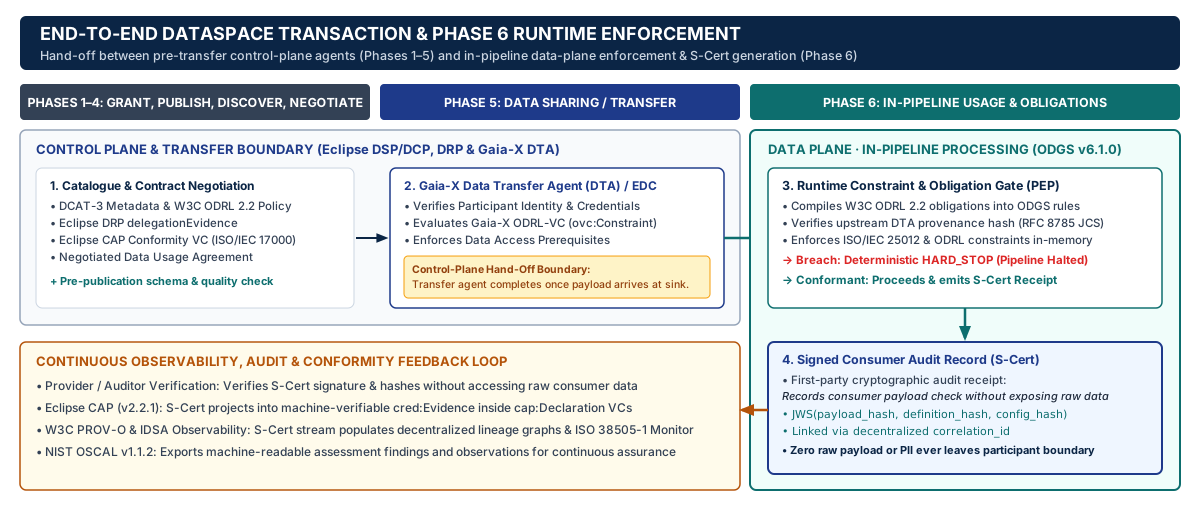
| Step | Protocol / Boundary | Message / Endpoint / Function | Description |
|---|---|---|---|
| 1 | Eclipse DSP (ISO/IEC DIS 26450) |
dspace:ContractAgreementMessage |
Provider and Consumer finalize the contract (odrl:Agreement @id). |
| 2 | Data Plane Signaling | DataFlowPrepareMessage / DataFlowStartMessage |
Consumer control plane signals consumer data plane with agreementId and processId (dataFlowId). |
| 3 | Control-to-Data Agreement Fetch | GET /transfers/:dataFlowId/agreement |
DataPlaneSignalingBridge.prepare_flow() retrieves the DSP agreement, classifies constraint observability, and compiles payload-observable checks. |
| 4 | ODGS Data-Plane PEP | DataPlaneSignalingBridge.evaluate_flow() |
Evaluates observable payload fields (PASS | HARD_STOP | SOFT_STOP | LOG_ONLY) and emits a consumer-signed S-Cert audit record. |
| 5 | Eclipse DSP Violation Callback | dspace:TransferSuspensionMessage / TransferTerminationMessage |
On SOFT_STOP or HARD_STOP, notifies the consumer control plane to suspend or terminate the DSP transfer with the provider. |
| 6 | Eclipse DCP + CAP (v2.2.1) |
PresentationQueryMessage → PresentationResponseMessage |
Consumer issues a DID-signed cap:Declaration VC into its CredentialService and presents it via DCP when queried by the provider. |