5-Plane Architecture & Standards Alignment (v6.1.0)
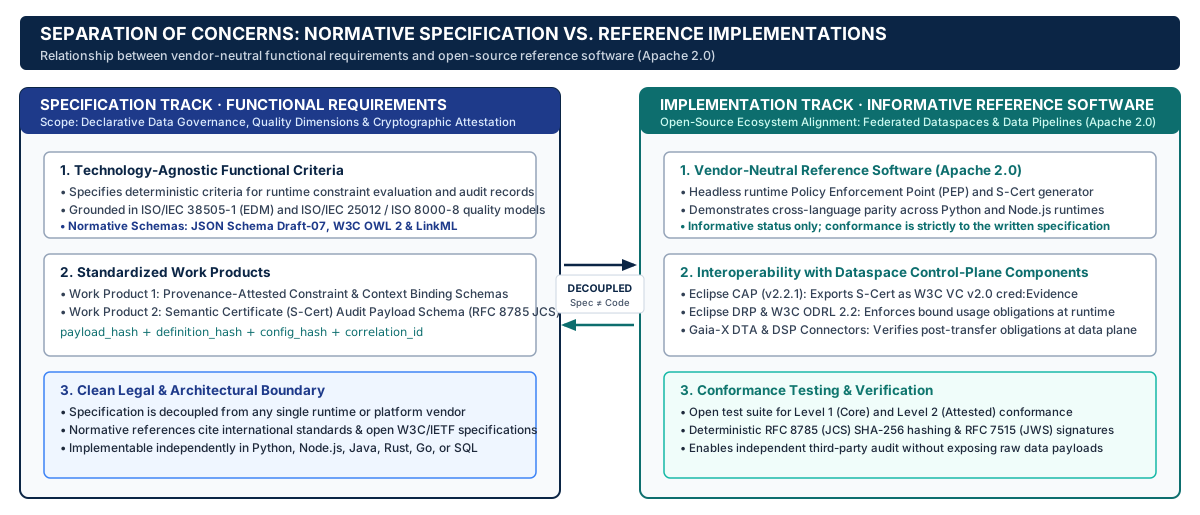
The Open Data Governance Standard (ODGS) (v6.1.0) specifies a deterministic architecture that separates declarative governance definitions from physical execution pipelines, closing both the Definition–Execution Gap inside enterprises and the Phase 6 Operationalisation Gap across federated dataspaces.
1. Two Complementary Governance Tracks
Data governance across modern data ecosystems operates along two complementary tracks:
- Pre-Transfer Control Plane (
Eclipse DSP/DCP,W3C ODRL 2.2,Eclipse DRP,Gaia-X Data Transfer Agent) — governs participant identity, catalog discovery, contract negotiation, and transfer authorization before data crosses an organizational boundary. - In-Pipeline Runtime Enforcement Plane (
ODGS v6.1.0) — governs deterministic payload evaluation (HARD_STOP,SOFT_STOP,LOG_ONLY) and cryptographic attestation (S-Cert) at the moment data is processed or consumed.
2. Three-Layer / Five-Plane Architecture
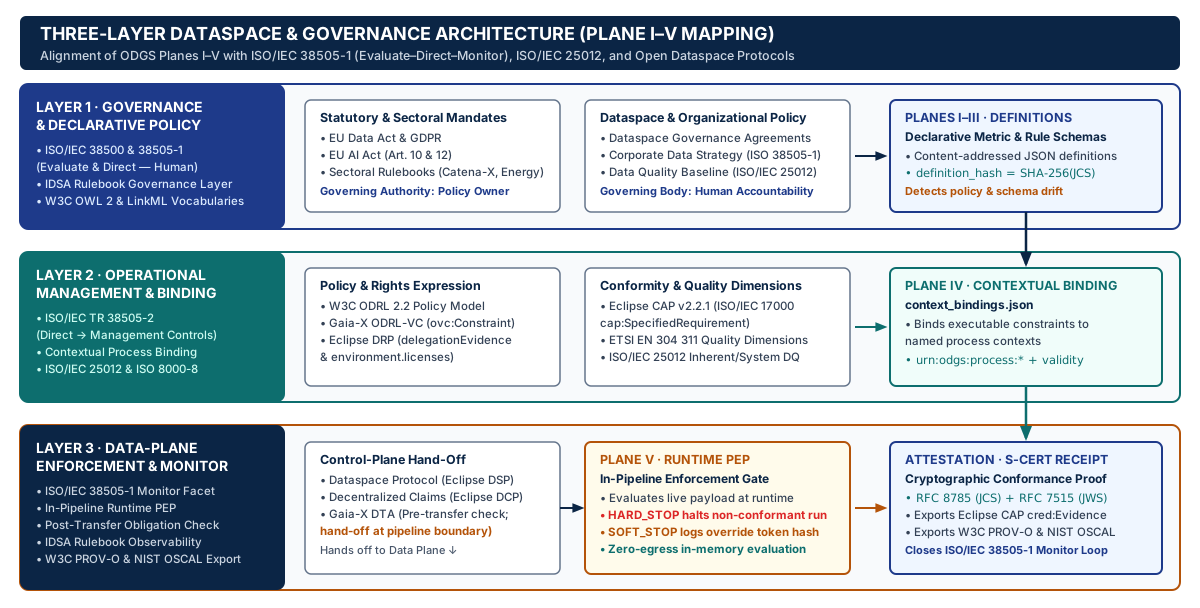
ODGS structures governance into Five Normative Planes grouped across three architectural layers grounded in ISO/IEC 38505-1:2026 (Evaluate — Direct — Monitor) and ISO/IEC 25012:2008 (Data Quality Model):
| Layer | ODGS Plane | Artifact / Schema | Normative Grounding |
|---|---|---|---|
Layer 1: Declarative Definition (Direct) |
Plane I — Regulatory & Contractual Baseline | W3C ODRL 2.2 agreements, statutory/sector packs |
W3C ODRL 2.2, EU AI Act Art. 10 & 12 |
Layer 1: Declarative Definition (Direct) |
Plane II — Semantic Metric & DQ Registry | 01-metrics-schema.json, standard_dq_dimensions.json, ontology_graph.owl |
ISO/IEC 25012:2008, ISO 8000-8, W3C OWL 2 |
Layer 1: Declarative Definition (Direct) |
Plane III — Deterministic Validation Logic | 02-rules-schema.json, standard_validation_rules.json |
Boolean / AST rule expressions, severity classification |
Layer 2: Contextual Binding (Evaluate & Direct) |
Plane IV — Contextual Process Binding | 03-ontology-schema.json, context_bindings.json |
ISO/IEC 38505-1:2026 & TR 38505-2:2018 |
Layer 3: Runtime Enforcement (Monitor) |
Plane V — Runtime PEP & Semantic Certificate (S-Cert) |
04-s-cert-schema.json, OdgsInterceptor, DataspaceRuntimePEP |
RFC 8785 (JCS), RFC 7515 (JWS), Eclipse CAP v2.2.1, W3C PROV-O, NIST OSCAL v1.1.2 |
3. Trustworthy Data Transaction (TDT) Sequence
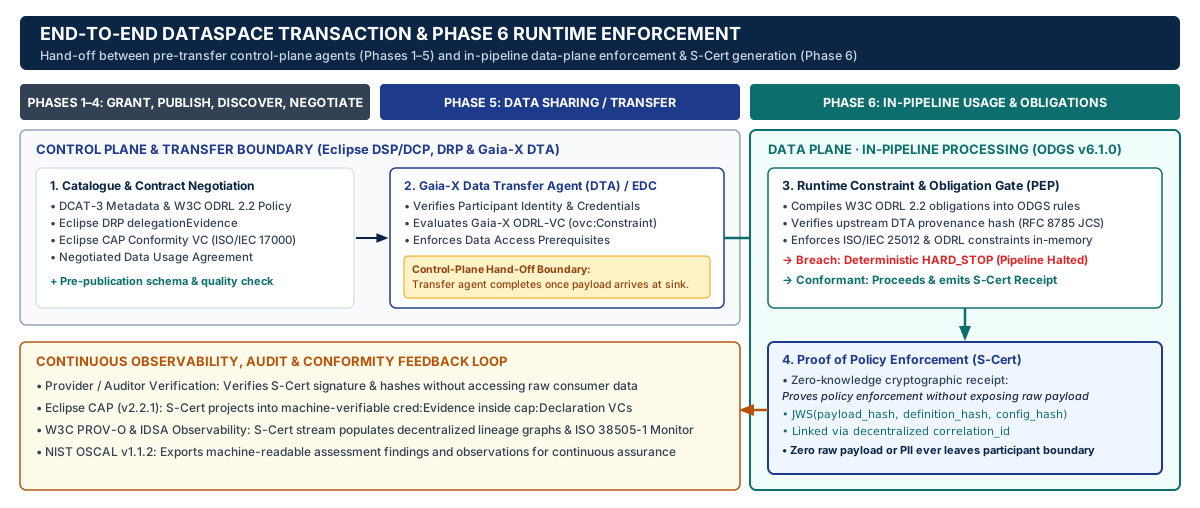
In a federated dataspace transaction across federated dataspace transactions (Phases 1–6), ODGS operates as the Phase 6 Runtime Policy Enforcement Point (PEP) at the processing boundary:
Step-by-Step Handshake
- Contract & Transfer Authorization (Phases 1–5): The Provider and Consumer negotiate a
W3C ODRL 2.2Agreement (odrl:Agreement) and execute data transfer with an upstream provenance digest (dta_provenance_hash). - ODRL-to-ODGS Compilation (
odrl_binder.py): The Consumer's boundary compilesodrl:obligationandodrl:prohibitionconstraints into deterministic Plane III rules and a Plane IV contextual binding (context_bindings.json). - Runtime Interception (
DataspaceRuntimePEP): Before the target pipeline (process_urn) executes, the PEP verifies upstream provenance (dta_verifier.py) and evaluates every bound constraint against the runtime payload or batch metadata. - Deterministic Enforcement:
HARD_STOP: RaisesAdministrativeRecusalError/ProcessBlockedExceptionand halts execution prior to sink commit.SOFT_STOP: Halts execution unless a cryptographicoverride_tokenis supplied and logged in the attestation.LOG_ONLY: Permits execution while recording the warning outcome in the audit trail.- Zero-Knowledge Attestation (
S-Cert): Emits an RFC 8785 JCS canonicalized receipt bindingpayload_hash,definition_hash, andconfig_hashwithout exposing raw payload records. - Multi-Format Conformity Projection: Exports the
S-Certinto Eclipse CAP v2.2.1 (cap:Declaration/cred:Evidence), W3C PROV-O (prov:Activity), and NIST OSCAL v1.1.2 (finding/observation).