Conformance Levels & Interoperability Profiles (v6.1.0)
This page documents the normative requirements for achieving ODGS Implementation Conformance (Level 1 Core and Level 2 Attested) and disambiguates them from federated dataspace capability profiles and conformity assessment vocabularies (ISO/IEC 17000 / Eclipse CAP v2.2.1).
1. Terminology Disambiguation
| Framework | Scope | Levels / Artifacts |
|---|---|---|
| ODGS Implementation Conformance | Applies strictly to software implementations of the ODGS specification (1_NORMATIVE_SPECIFICATION/conformance_rules.md). |
Level 1 Core (L1), Level 2 Attested (L2) |
| Dataspace Capability Profiles | Interoperability capability stages across federated dataspace ecosystems (from pre-transfer cataloging and contract negotiation to runtime obligation enforcement). | Pre-transfer control plane vs. in-pipeline runtime enforcement |
| ISO/IEC 17000 & Eclipse CAP v2.2.1 | Formal conformity assessment vocabularies into which ODGS projects cryptographic runtime evidence. | cap:ConformityAssessmentScheme, cap:Declaration, cred:Evidence |
2. ODGS Implementation Conformance Levels (L1 & L2)
The key words MUST, MUST NOT, REQUIRED, SHALL, SHALL NOT, SHOULD, and MAY follow RFC 2119.
| Level | Designation | Normative Requirements | Verification Command |
|---|---|---|---|
| L1 | Level 1 Core | Planes II–IV JSON artifacts exist and validate against Draft-07 JSON Schemas (01-metrics-schema.json, 02-rules-schema.json, 03-ontology-schema.json), with data quality dimensions grounded in ISO/IEC 25012:2008. |
odgs conformance --level L1 |
| L2 | Level 2 Attested | Satisfies L1 plus full cross-reference integrity across context_bindings.json, deterministic HARD_STOP/SOFT_STOP/LOG_ONLY enforcement, RFC 8785 (JCS) canonical hashing, and 04-s-cert-schema.json attestation emission. |
odgs conformance --level L2 |
Core Conformance Requirements
- Semantic & Contextual Decoupling (
ISO/IEC 38505-1): Policy definitions (Planes I–III) SHALL be strictly decoupled from contextual process bindings (Plane IV) and physical execution (Plane V). Hard-coding legal, contractual, or data quality definitions inside application execution logic constitutes non-conformance. - Ontology & Data Quality Baseline (
ISO/IEC 25012): Governance artifacts MUST validate against the normative JSON Schemas and the W3C OWL 2 / LinkML ontologies (ontology_graph.owl,odgs_dataspace.linkml.yaml). - Deterministic Enforcement (
HARD_STOP,SOFT_STOP,LOG_ONLY): - When a
HARD_STOPrule fails, the PEP SHALL halt execution (ProcessBlockedException/AdministrativeRecusalError) and MUST NOT probabilistically impute or bypass the failed constraint. - When a
SOFT_STOPrule fails, the engine SHALL halt execution unless a validoverride_tokenis supplied, and MUST record the SHA-256 digest of the override token in the resulting attestation. - Cryptographic Attestation (
S-Cert— Zero-Knowledge Auditing): Upon completing an evaluation (APPROVED,SOFT_STOP_OVERRIDDEN, orBLOCKED_HARD_STOP), a Level 2 conformant implementation MUST emit a canonical Semantic Certificate (S-Cert) bindingpayload_hash,definition_hash, andconfig_hashvia RFC 8785 (JCS) without transmitting raw data payloads to external third-party servers.
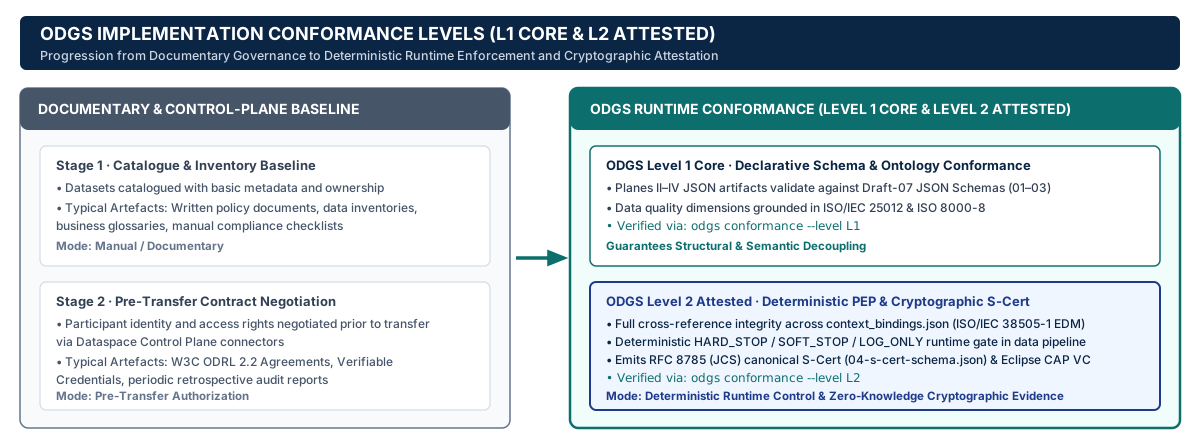
3. Progression from Documentary Baselines to Runtime Conformance
While pre-transfer connectors address cataloging, participant identity, and contract negotiation (W3C ODRL 2.2), ODGS provides the normative in-pipeline runtime enforcement and cryptographic evidence required for automated policy verification and continuous conformity assessment: